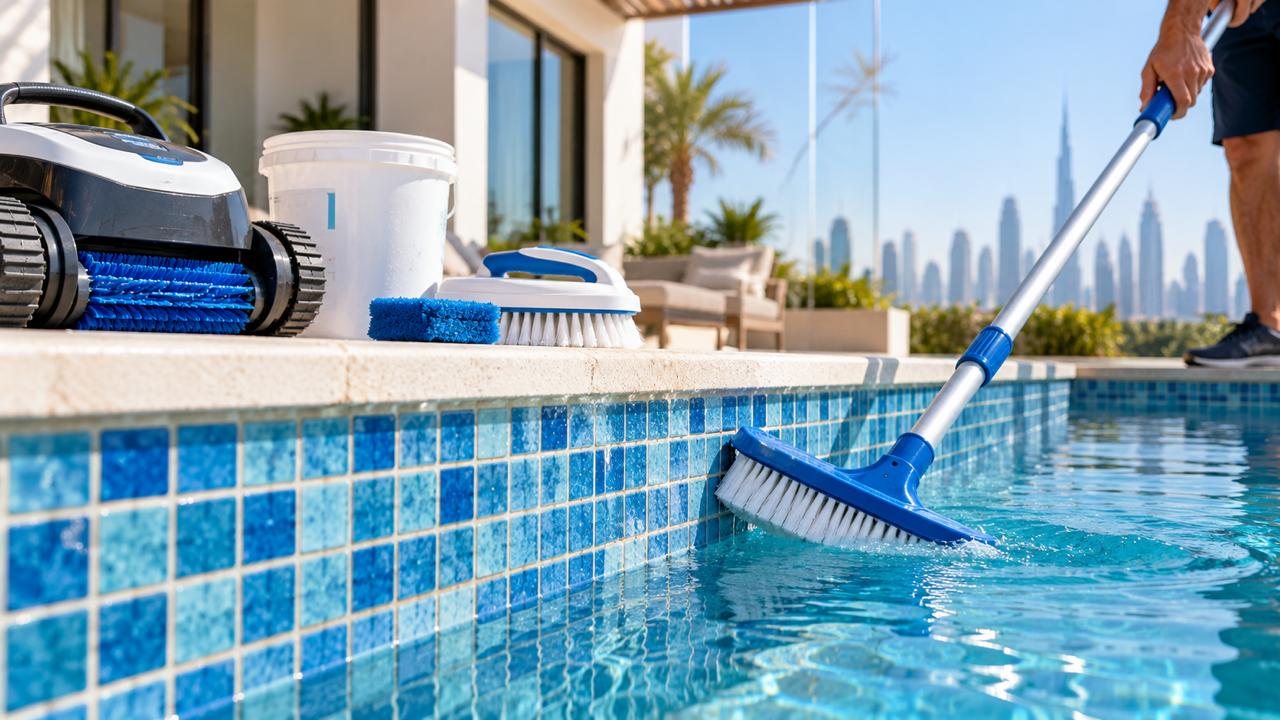
Pool Cleaners Dubai: Best Pool Tile Cleaning Tips and Tools
The white crust along your waterline is not dirt, and scrubbing harder will not remove it.
It is calcium scale: mineral deposits left behind as water evaporates at the surface. In Dubai, where evaporation runs far above what most pool guidance assumes, it forms faster than almost anywhere else. Villa owners here often find their waterline needs attention within months of a pool being finished.
It is manageable. The important part is matching the method to the type of scale and the type of tile, because the wrong combination damages tile permanently.
First, Identify the Scale
Calcium carbonate appears as white, flaky, relatively soft deposits. It responds to mild acids and light abrasion.
Calcium silicate appears as harder, grayish-white scale. It forms more slowly, is far more stubborn, and generally does not respond to vinegar or mild acid at all.
A simple test apply a small amount of dilute acid to a deposit. Bubbling means calcium carbonate. No reaction means calcium silicate.
This matters because meeting calcium silicate with carbonate tools means scrubbing with increasing force against something that will not shift, and the tile loses that contest. Silicate is usually a job for professional treatment.
Second, Identify Your Tile
This is where most permanent damage originates.
Ceramic and porcelain are the most forgiving. They tolerate a pumice stone used correctly and handle acid-based cleaners.
Glass tile does not tolerate abrasion. A pumice stone will scratch it, permanently and visibly. Glass needs chemical methods and soft tools only, which matters in Dubai where glass mosaic is a popular villa pool finish.
Natural stone varies, and many stones are acid-sensitive. Acid can etch limestone and marble, so test on an inconspicuous area first.
Fibreglass and vinyl should never meet a pumice stone. They are softer than the tool and will scratch.
If you do not know your tile, find out before starting. It should be in your handover documentation.
The Tools Worth Having
Nylon or soft-bristle brush : The workhorse for routine waterline wiping. Safe on every surface.
Pool tile sponge or non-scratch pad : For regular grime and oil before it hardens.
Pumice stone (pool grade) : Effective on hardened carbonate on ceramic, porcelain and concrete. Two rules: keep both stone and tile wet at all times, and use gentle circular motions rather than pressure. A dry pumice stone scratches. Never use on glass, fibreglass or vinyl.
White vinegar : A mild acid that dissolves thin, fresh carbonate and cuts oily grime. Mix equal parts with water in a spray bottle. The right first attempt for light deposits, though test on acid-sensitive stone.
White vinegar : A mild acid that dissolves thin, fresh carbonate and cuts oily grime. Mix equal parts with water in a spray bottle. The right first attempt for light deposits, though test on acid-sensitive stone.
Baking soda paste : A mild abrasive that lifts grime without scratching, useful on surfaces too delicate for pumice.
Commercial scale remover : Products formulated for pool calcium, often sulfamic acid based, sitting between vinegar and stronger acids. Follow instructions and wear gloves.
Methods, From Mild to Heavy
Work up this list. The gentlest method that works is the right one.
Weekly wipe : Wipe the waterline with a soft brush before deposits harden. This is the entire trick to avoiding heavy scale, and it takes a few minutes.
Vinegar treatment : Spray the equal-parts solution, leave three to five minutes, scrub with a nylon brush, rinse. Effective monthly as prevention.
Baking soda paste : Apply, scrub gently, rinse. Good for grime on delicate surfaces.
Pumice stone : Hardened carbonate on ceramic, porcelain or concrete only. Keep stone and tile wet throughout, scrub gently, stop at any sign of marking.
Commercial scale remover : For deposits resisting vinegar. Allow the stated dwell time, then follow with brush or pumice depending on surface. Run the filter afterwards and avoid swimming during treatment.
Professional treatment : Heavy or widespread scale, and calcium silicate in particular. Bead blasting uses fine media to remove scale without the force that damages tile.
What Never to Use
- Razor blades or metal scrapers : They scratch tile and destroy grout.
- Steel brushes or scouring pads : Same problem, over a wider area.
- Undiluted acid on tile : Damages tile, grout and surroundings, and is hazardous to handle.
- A dry pumice stone : Scratches even tile it is otherwise safe on.
- Pumice on glass, fibreglass or vinyl : Permanent, visible scratching.
- High-pressure washing : Can damage grout and dislodge tile.
- Draining the pool to clean tiles : In Dubai's heat an empty pool faces structural risk and finishes can crack.
Stopping Scale Coming Back
Cleaning treats the symptom. Chemistry treats the cause. Scale forms when calcium comes out of solution, which happens when calcium hardness runs high, when pH climbs, or both. Cleaning without correcting chemistry means repeating the job in a few months.
Target ranges : pH 7.2 to 7.6, total alkalinity 80 to 120 ppm, calcium hardness 200 to 400 ppm. Above 400 ppm hardness, deposits form readily, and high pH has the same effect because calcium becomes less soluble as pH rises.
Beyond that: test regularly and correct drift early, wipe the waterline weekly, consider a scale inhibitor if your fill water is hard, and keep the water topped up. That last point matters particularly here, since high evaporation both concentrates minerals and exposes more tile at the waterline, which is the exact combination that produces heavy scale.
When to Call a Professional
Handle it yourself if deposits are light to moderate, the tile is ceramic or porcelain, and vinegar or pumice is making progress.
Call someone if the deposit does not respond to acid, the tile is glass and scale has hardened, the scale covers a large area, grout is deteriorating alongside it, or the scale keeps returning quickly. Professional tile cleaning generally costs less than replacing tile damaged by an aggressive attempt to clean it.
Frequently Asked Questions
A light weekly wipe prevents most buildup, with a monthly vinegar treatment. Deep cleaning then becomes an annual job rather than a recurring battle.
High evaporation. As water evaporates it leaves dissolved minerals at the waterline, and Dubai's rates are far above those assumed in most international guidance.
On ceramic, porcelain and concrete, yes, provided both stone and tile stay wet and pressure stays gentle. Never on glass, fibreglass or vinyl, where it scratches permanently.
Apply a small amount of dilute acid. Bubbling indicates carbonate. No reaction indicates silicate, which needs professional treatment.
Waterline cleaning is normally done with the level lowered slightly. Fully draining in Dubai's heat carries structural and cracking risks.
Not alone. Scale forms because of water chemistry, so unless calcium hardness and pH are brought into range it will reform.
It depends on the extent of scale, the tile type, and whether bead blasting is required. Contact us with details of your pool for a quotation.


